
As our community prepares for the upcoming November general election, voters across Oklahoma will see State Question 847 on the ballot. Because property valuations and local tax revenues directly sustain our local schools and other county services, I want to share a clear look at how SQ 847 could impact our school district’s classrooms, facilities, and long-term financial stability.
State Question 847 is a proposed constitutional amendment that would lower the cap on annual property value growth for tax assessment purposes starting in tax year 2027: Homestead and Agricultural Property value would be capped at an annual taxable increase of 1.75% down from the current 3% limit. Commercial & Rental Property would also be lowered from the current cap of 5% to 4%. Senior property protections would be modified based on an income tier for homeowners aged 65 and older.
It is important to note that SQ847 does not lower current property taxes or existing taxable property values. Instead, it restricts how quickly assessed valuations can keep pace with inflation and local community growth over time.
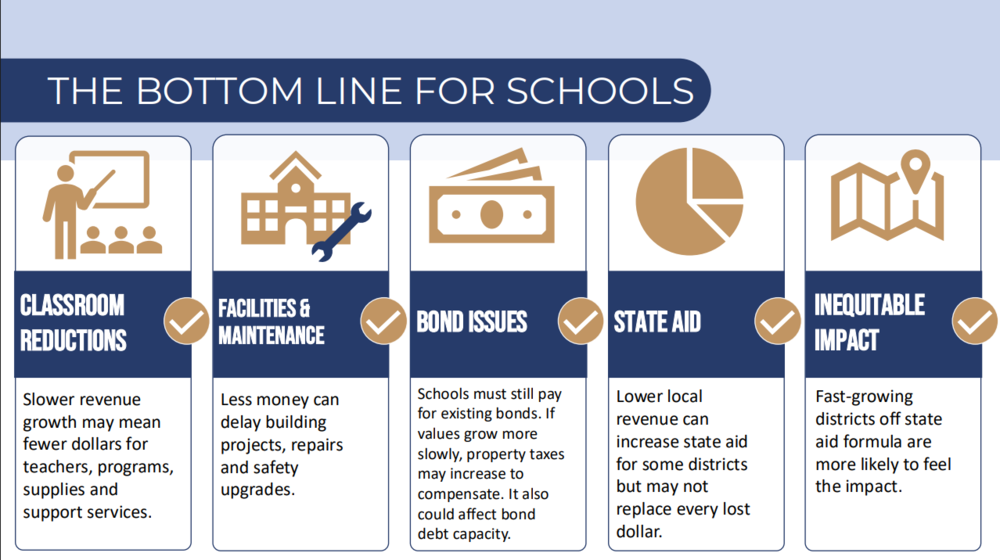
Local property taxes are a primary source for our district’s building, transportation and technology investment needs. Property tax revenues directly fund projects like building repairs, safety upgrades, new classrooms, new roofs and playgrounds through voter approved bond issues. Ongoing general maintenance like HVAC repairs, transportation fleet repairs, furniture replacement and general upkeep of the buildings are dependent on local property tax mills dedicated for the local building fund.
The key impacts to our school district could limit the school by creating funding gaps due to rising costs in school maintenance, utilities, construction materials and new technologies. When local communities grow at a slower rate a school district’s ability to modernize facilities, replace aging buildings and equipment becomes more challenging without adjusting millage rates. Additionally, legislation has no current plan to replace the potential revenue lost by local school districts, career technology centers, or county services.
Oklahoma public education funding already operates behind other regional educational funding. According to data tracked by the Oklahoma State School Board Association (OSSBA) and national education databases, Oklahoma consistently ranks last in its region (including Kansas, Arkansas, Missouri, Texas, Colorado, and New Mexico.) Even following recent state budget increases and teacher salary raises, Oklahoma continues to trail neighboring states overall per-pupil financial support for K-12 education.
Ultimately, State Question 847 extends far beyond local tax mechanics, it directly shapes what happens inside our classrooms every day. By suppressing the growth of local property tax bases, SQ 847 risks creating compounding funding gaps that make it harder to hire and retain qualified teachers, purchase up-to-date instructional technology, and replace outdated facilities. When school districts struggle to keep pace with rising inflation and operational costs, the burden often manifests in larger class sizes, reduced academic and vocational electives, and delayed facility improvements. As our community heads to the polls this November, I would encourage all district residents and families to stay informed on how SQ 847 and our local tax structures could impact how our community supports our students with championship-level experiences, environments, and expectations will be essential to shaping our community and the public schools, libraries, and emergency services that operate for all of us. We are Grove!